

By BestSeal Engineering Team | | Reading time: 11 min
The short version: Most mechanical seal failures aren't defects. They're wrong selections. This guide walks through every decision point — seal type, face material, pressure rating, standards, and what people get wrong.
1. What a Mechanical Seal Actually Does
A mechanical seal stops fluid from leaking out along the pump shaft.
Two flat faces — one rotating, one stationary — press against each other. A thin fluid film between them does the lubrication. Spring force keeps them in contact.
That's it. Simple concept. Complicated execution.
Centrifugal pumps are the most common application. The seal sits where the shaft exits the pump casing. It replaced gland packing decades ago in most industrial settings.
Why does it matter? A $40 seal in the wrong material costs $4,000 in downtime when it fails at 2 a.m. on a Saturday.
Industry data puts it plainly: over 70% of mechanical seal failures are caused by wrong selection or bad installation. Not defective parts.
Getting the spec right before ordering is the only thing that matters.
2. Start Here: Your Operating Conditions
You need four numbers before you can spec a seal. Fluid type. Temperature. Pressure. Shaft speed.
Miss any one of them and you're guessing.
Fluid Type
This is the most critical variable. One wrong elastomer and the seal is dead in weeks.
| Fluid | Face Pair | Elastomer |
|---|---|---|
| Clean water, general use | Carbon / SiC | NBR or EPDM |
| Diesel, lube oil, hydrocarbons | Carbon / SiC or TC | FKM (Viton) |
| Sulfuric acid, HCl | SiC / SiC | PTFE or FKM |
| Caustic soda (NaOH) | Carbon / Sintered SiC | EPDM |
| Abrasive slurry, dye paste | SiC / SiC | FKM or EPDM |
| Pharmaceutical, sterile | Carbon / Sintered SiC | EPDM or FFKM |
| Solvents (MEK, acetone) | Carbon / SiC | FFKM |
Printing and dyeing lines often combine dye pastes, surfactants, and bleach. SiC vs. sintered SiC faces with FKM or EPDM secondary seals cover most of these.
Food and pharmaceutical applications require FDA-compliant materials. That means FDA 21 CFR 177.2600 for elastomers. Not optional.
Temperature
| Range | Elastomer | Notes |
|---|---|---|
| –20°C to +90°C | NBR or EPDM | Standard |
| +90°C to +180°C | FKM (Viton) | Upgrade springs to Hastelloy |
| +180°C to +220°C | PTFE bellows or FFKM | Stellite-coated faces |
| Below –20°C | Low-temp FKM or PTFE | Verify spring metal grade |
One thing kills more seals than people admit: thermal shock.
Cold CIP solution hitting a hot pump. Silicon carbide cracks in milliseconds. If your process has clean-in-place cycles, don't spec alumina ceramic or standard reaction-bonded SiC faces.
Pressure
Below 0.8 MPa: a single seal is fine.
0.8 to 1.6 MPa: single seal still works, but it needs a balanced design.
Above 1.6 MPa: use a double mechanical seal with a pressurized barrier fluid system.
Vacuum service is a special case. Face hydraulic balance behaves differently below atmospheric. Talk to the manufacturer before specifying.
Shaft Speed (RPM)
Higher speed means more heat at the seal face.
The PV value — Pressure × Velocity — must stay within the seal's rated limit. Standard carbon-SiC pairs handle roughly 3 to 5 MPa·m/s. Beyond that, use tungsten carbide or reaction-bonded SiC, and ensure adequate cooling in the flush plan.
3. Single or Double Seal?
This is the first real decision.
Single Mechanical Seal
One pair of sealing faces. The pumped fluid lubricates the interface. A small amount of vapor escapes to atmosphere.
Use it for non-hazardous fluids. Moderate pressures under 1.0–1.2 MPa. Applications where zero emissions aren't a regulatory requirement.
It's cost-effective and covers the majority of general industrial pump applications.
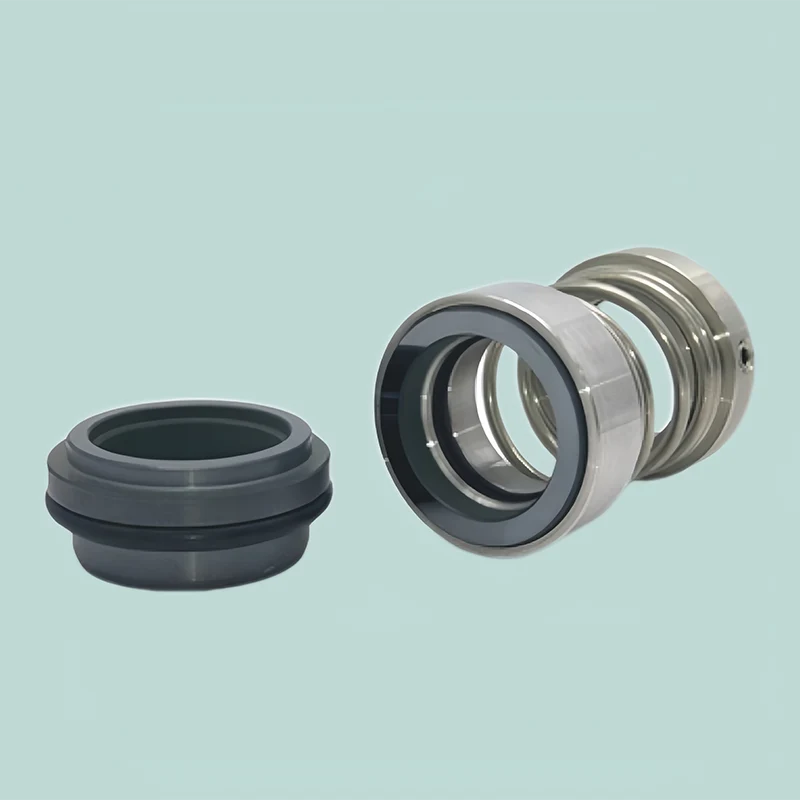
View BestSeal standard single mechanical seals →
Double Mechanical Seal
Two seal pairs. A barrier or buffer fluid circulates between them.
Two configurations matter:
Back-to-back (pressurized): Barrier fluid pressure sits 1.5–2 bar above process pressure. If the inboard seal leaks, barrier fluid enters the process — not process fluid to atmosphere. Required for toxic, flammable, or carcinogenic fluids.
Tandem (unpressurized): Buffer fluid pressure is below process pressure. A small amount of process fluid leaks inward. Nothing reaches atmosphere. Standard in pharmaceutical and food applications where barrier fluid must not contaminate the product.
Use a double seal when the fluid is toxic, hazardous, or expensive. When pressure exceeds 1.2 MPa. When regulations require zero atmospheric emissions — EPA, ATEX, GMP.
4. Seal Face Materials
The faces do the actual sealing. Material selection determines everything else.
Carbon-Graphite
The most common rotating face material. Self-lubricating. Good thermal conductivity.
Not for strong oxidizing acids. Not for abrasive slurries.
Silicon Carbide (SiC)
Two grades. This distinction matters.
Reaction-bonded SiC (RBSiC): Lower cost. Contains 10–15% free silicon. Alkalis attack it. Do not use in sodium hydroxide or potassium hydroxide service.
Sintered SiC (SSiC): Pure silicon carbide. No free silicon. Superior chemical resistance. Handles alkalis. Required for pharmaceutical applications. Higher cost — worth it.
Tungsten Carbide (WC)
Extremely hard. Excellent for abrasive slurries. Good acid resistance.
Two binder types: cobalt-bonded (not for strong acids — cobalt leaches) and nickel-bonded (acid-resistant). Metallurgy and mining applications use this almost exclusively.
Alumina Ceramic
Low cost. Works fine in clean water.
Brittle. Terrible thermal shock resistance. Don't use it anywhere with temperature cycling.
Face Pair Recommendations
| Application | Rotating Face | Stationary Face |
|---|---|---|
| General process water | Carbon-Graphite | RBSiC |
| Printing and dyeing | Carbon-Graphite | Sintered SiC |
| Metallurgy, slurry | Sintered SiC | Sintered SiC |
| Caustic (NaOH) — not RBSiC | Carbon or TC | Sintered SiC |
| Pharmaceutical, food | Carbon-Graphite | Sintered SiC |
| Hot oil, automotive | Carbon-Graphite | Tungsten Carbide |
| Aerospace, spacecraft | Application-specific | Consult manufacturer |
5. O-Rings and Secondary Seals
Engineers spend hours selecting face materials. Then they spec the wrong O-ring. The seal fails in days.
| Elastomer | Best For | Temperature Range |
|---|---|---|
| NBR (Nitrile) | Oil, water, mild chemicals | –30°C to +100°C |
| EPDM | Steam, hot water, alkalis, food | –40°C to +150°C |
| FKM (Viton) | Fuels, oils, acids, solvents | –20°C to +200°C |
| PTFE bellows | Near-universal chemical resistance | –200°C to +260°C |
| FFKM | Aggressive solvents, pharmaceutical, plasma | –20°C to +327°C |
FKM in an ammonia system: dead in a week. EPDM is the correct choice for ammonia.
Always cross-check the elastomer against the specific fluid at the actual operating temperature. Not just the fluid name.
6. Dimensional Standards
Your seal must match the pump's gland plate, stuffing box bore, and shaft diameter exactly.
Three standards dominate globally.
EN 12756 (ISO 3069): The dominant standard in Europe, Asia, and most export markets. Three series — L1 (most common, single seals), L2 (larger gland), L3 (double seals and cartridge seals).
ASME B73.1: North American standard. Used by Goulds, Flowserve, ITT, Durco, and other US pump manufacturers.
GB/T 33509: China national standard. Harmonized with ISO 3069 for most dimensions. Cross-compatible with EN 12756 L1 in standard shaft size ranges.
When replacing an existing seal, don't guess the standard. Provide the pump brand, model number, shaft diameter at the seal location, stuffing box bore, and gland bolt circle diameter.
A good manufacturer will cross-reference the dimensions without needing a drawing.
Download BestSeal product specifications and technical drawings →
7. Cartridge vs. Component Seals
Component Seal
Sold as individual parts. Assembled onto the shaft on-site. Lower component cost.
Installation requires precise measurement. Spring compression must be exact. One wrong step and you're replacing the seal again in three months.
Cartridge Seal
Pre-assembled. Slides onto the shaft as a complete unit. Set screws lock it in place. Done.
Installation time: 30–60 minutes versus 2–3 hours for a component seal. Most installation errors disappear entirely.
Is the higher upfront cost worth it? When a pump runs 24/7 and downtime costs $500 per hour, yes.
Specify cartridge seals for: critical continuous-service pumps, double seal arrangements, pharmaceutical and food plants with validated assembly requirements, sites with limited maintenance skill levels.
8. Industry-Specific Notes
Pharmaceutical
All wetted materials must be FDA-compliant. 316L stainless hardware. EPDM or FFKM elastomers. Sintered SiC faces.
Metal surface finish: Ra ≤ 0.8 μm. Above that, microbial adhesion becomes a real risk.
Tandem double seals are standard in sterile filling and API synthesis. CIP compatibility is non-negotiable — daily cycling between pH 12 caustic at 80°C and pH 2 acid rinse at 70°C destroys the wrong seal combination.
Food Processing
3-A Sanitary Standards in North America. EHEDG in Europe. Material requirements are nearly identical to pharmaceutical.
CIP cycles are the main failure driver here. Test your material combination against your actual cleaning protocol, not a generic "food grade" claim.
Metallurgy
High abrasion. High temperature. Aggressive chemistry. All at once.
SiC vs. SiC faces. Hastelloy C springs. External flush — API Plan 32 — is standard. Cartridge seals are preferred because installation environments are rough.
Printing and Dyeing
Dye pastes contain fine abrasive pigment particles. Carbon vs. sintered SiC with FKM or EPDM secondary seals handles most dye industry fluids.
Maintenance intervals are shorter than clean-fluid applications. Budget for it.
Automotive
Coolant pumps, oil transfer, gear oil circulation. Standard carbon vs. SiC covers most plant utilities.
For cutting fluid service, verify FKM compatibility with the specific fluid chemistry — cutting fluid formulations vary widely.
Aerospace and Spacecraft
The hardest application class on this list. Liquid oxygen. Liquid nitrogen. Kerosene fuels. Cryogenic temperatures.
Standard seals don't apply here. Titanium hardware, specialty FFKM grades, and special carbon-graphite formulations. Every application requires custom engineering and documented test protocols.
9. Balanced vs. Unbalanced Seals
This distinction gets ignored more than it should.
Unbalanced seal: Full sealing pressure acts on the entire face area. Simple design. Suitable up to about 0.5–0.8 MPa. Generates significant heat at higher pressures.
Balanced seal: The rotating ring geometry is stepped. Hydraulic pressure acts on only 65–80% of the face area. Less heat. Longer face life at elevated pressure.
When does balance matter? When sealing pressure exceeds 0.7 MPa (7 bar). When shaft peripheral velocity exceeds 8 m/s.
Pharmaceutical and food applications should use balanced seals regardless of pressure. They run cooler. Less contamination risk.
10. What Buyers Get Wrong
Six patterns. Seen them all.
Ordering on price alone. The cheapest seal with incompatible material fails in weeks. The correct seal at 30% more cost runs for three years.
Providing shaft diameter only. A seal can fit the shaft and be completely wrong for the pump housing. Stuffing box dimensions matter just as much.
Specifying RBSiC for caustic service. Free silicon dissolves in NaOH. Always. Specify sintered SiC for any alkali application.
Wrong O-ring. Carbon-SiC faces, correct. Viton O-ring in ammonia service. Dead in days. Check the elastomer compatibility, not just the face material.
No surface finish specification for pharmaceutical. "316L stainless steel" is not a complete specification. Ra value must be documented.
Ignoring thermal cycling. If your pump gets hot-cold-hot regularly — CIP, steam-out, batch processing — alumina ceramic faces will crack. It's not a question of if, but when.
11. Request a Cross-Reference or Custom Quote
BestSeal manufactures both standard and custom-engineered mechanical seals.
Standard seals conform to EN 12756, ASME B73.1, and GB/T 33509. Custom seals cover non-standard shafts, extreme temperature ranges, and special media requirements.
We also provide cross-reference and direct replacement service for all major seal brands — at 40–60% lower cost in most cases.
What we make:
- Standard and custom single mechanical seals
- Standard and custom double mechanical seals — back-to-back and tandem
- Cartridge seals for critical and pharmaceutical applications
- Face materials: Carbon-Graphite, RBSiC, Sintered SiC, Tungsten Carbide
- Secondary seals: NBR, EPDM, FKM, PTFE, FFKM
Send an Inquiry → Provide your pump model, shaft diameter, fluid, pressure, and temperature. Our team responds within 24 hours.
12. FAQ
What is the most common mechanical seal for a centrifugal pump?
Single, unbalanced seal. Carbon-graphite rotating face, silicon carbide stationary seat, NBR or EPDM O-rings. EN 12756 L1 dimensional standard. Covers most general-purpose process water and utility pump applications.
How do I know if I need a double mechanical seal?
Three triggers: the fluid is toxic, flammable, or highly regulated. Sealing pressure exceeds 1.0 MPa. Or your application requires zero atmospheric emissions under EPA, ATEX, or GMP rules.
Can I replace an OEM mechanical seal with a third-party equivalent?
Yes, in most cases. Provide the OEM brand, part number, and pump model. A manufacturer with cross-reference capability will match the dimensions and often upgrade the materials in the process — typically at 40–60% lower cost.
What causes premature mechanical seal failure?
Dry running. Wrong material selection. Installation error. Shaft runout or bearing wear. Cavitation. Thermal shock from CIP cycles. In that order of frequency.
What is the difference between reaction-bonded SiC and sintered SiC?
Reaction-bonded SiC (RBSiC) is less expensive but contains 10–15% free silicon, which is attacked by strong alkalis. Sintered SiC (SSiC) is pure silicon carbide with no free silicon. Superior chemical resistance. Required for alkali and pharmaceutical service.
How long should a mechanical seal last?
Correctly selected and properly installed: 2–5 years in continuous service. Demanding applications — high temperature, abrasive media, frequent stops and starts — expect 6–18 months. Failure under 6 months almost always means wrong selection or installation error.
Do you make custom mechanical seals for non-standard shaft sizes?
Yes. BestSeal manufactures custom mechanical seals for non-standard shaft sizes, special gland configurations, unusual materials, and OEM replacement designs. Contact our engineering team with your drawings or dimensions.